
Weld County Court Arrest Records
After a Weld County jail arrest, the sheriff record and the court record answer different questions. Sheriff Steve Reams' office operates the jail reports that show the booking event: arrest date, arresting agency, booking number, charge line, bail amount, and sometimes a VINELink status link. The court record shows the case path: filed charge, court date, judge or division, case status, disposition, and final result when one exists.
The Weld County District Attorney prosecutes state criminal actions in the 19th Judicial District, which coincides with Weld County. The county DA page names Michael J. Rourke as District Attorney and describes the office as the prosecutor for felony and misdemeanor charges. That office can file charges that do not match the jail "Arrested for" text exactly. For booking and custody details, use Weld County jail inmate records. For booking-photo issues, use Weld County jail mugshots.
Search Weld Court Records After Arrest
The official court starting point is the Weld County Combined Courts page and the Colorado Judicial Branch docket search. Dockets are useful for court-date lookup. For statewide case-status and conviction checks, sheriff release-report text points users to Colorado court-record resources such as CoCourts. Older files or document-level searches may require the Weld Combined Courts record search form.
- Pull the sheriff arrest entry and write down the exact name, DOB, booking number, arrest date, arresting agency, and charge lines.
- Check the Weld release report for bond type, judge or agency, bond number, and release date.
- Search Colorado Judicial Branch dockets for Weld County appearances by name, date, or case number when available.
- Use CoCourts or a court records request when the docket does not provide enough case detail.
- Compare the court-filed charge to the jail charge before treating any arrest line as the final case record.
The Colorado docket search page is the right source for court-date lookup after a Weld County jail arrest.
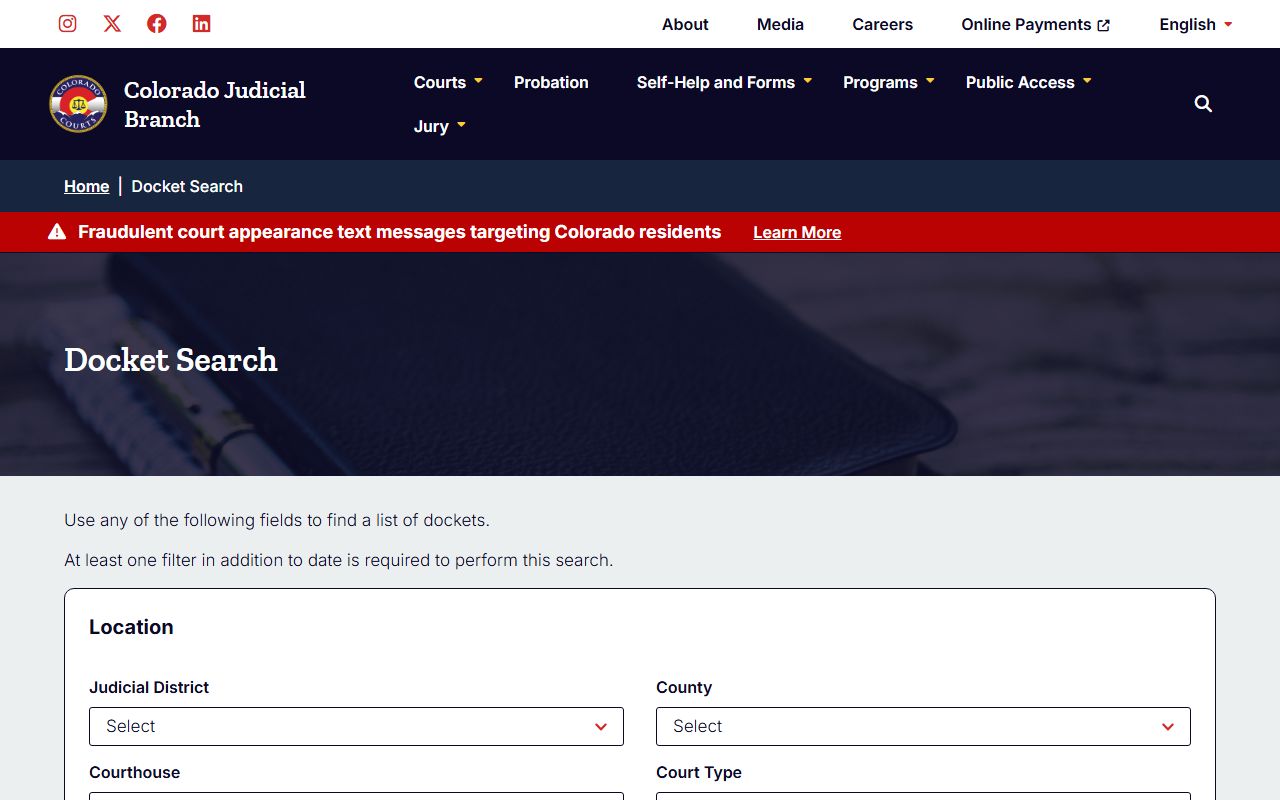
The docket screenshot fits this page because jail reports do not show every court setting or later charge status.
Weld Court Search Fields
Use the identifiers from the jail record to narrow the court search. A common name alone is weak. DOB, arrest date, and charge context can help avoid matching the wrong defendant, while a court case number is stronger when it appears on bond paperwork or court notices.
| Field Label | Type | Required | Notes |
|---|---|---|---|
| County or Court | Dropdown or filter | Usually required | Select Weld County or the relevant Weld court when available. |
| Date | Date filter | Often required for dockets | Use to locate scheduled appearances. |
| Party name | Text | Optional or varies | Use the legal name from the jail report. |
| Case number | Text | Optional but strongest | Use if shown on court or bond paperwork. |
| Search or Submit | Button | Yes | Runs the docket or case lookup. |
Charges Filed After Arrest
The jail report starts with a booking charge. The court record begins when the prosecutor or court filing turns that arrest into a case. Complaint, information, and indictment are three common charging-document terms. The exact document depends on the case type and procedure, but the practical point is the same: a filed charge is the court record that must be tracked for status and outcome.
| Document | Filed By | Common Use | Why It Matters |
|---|---|---|---|
| Complaint | Officer or prosecutor | Often early criminal case filings | Can begin the court case after arrest. |
| Information | Prosecutor | Many felony prosecutions | States formal prosecutor-filed charges. |
| Indictment | Grand jury | Serious or grand-jury matters | Charges are returned by a grand jury. |
Weld Charge Status
Charge status can change as the case moves. A pending charge is open. An amended charge has been changed. A reduced charge resolves or moves forward as a lesser offense. A dismissed charge is no longer being pursued in that form. A disposition is the final outcome, such as conviction, dismissal, deferred judgment, acquittal, or plea.
| Status | What It Means |
|---|---|
| Pending | The filed charge or case remains open and has not reached final disposition. |
| Amended | The statute, wording, level, or charge count changed after filing. |
| Reduced | The case moves forward or resolves as a lesser charge. |
| Dismissed | The charge or case is no longer pursued or has been terminated by court or prosecutor action. |
| Disposition | The final case result, such as conviction, dismissal, plea, acquittal, or deferred judgment. |
Bond After Weld Arrest
Bond details may appear in the jail release report, but the court order controls the legal release conditions. Weld's jail page explains cash bonds, surety bonds, PR bonds, cash-only, cash/surety, no-bond, and resolved outcomes. Cash or cashier's check is required for cash bonds at the jail, and cashier's checks or money orders must be payable to the Weld County Sheriff's Office. Online cash bond may be available through the authorized platform.
The Weld jail page's Colorado bond-rights notice is important. Booking fees, bond fees, and other debts do not have to be paid to secure release on a money bond. A payer needs to pay the bond amount. A $10 bond fee and a maximum 3.5% credit-card payment fee may be charged as debt after release if not paid at bonding. Surety bond fees are different because those are nonrefundable fees paid to a bondsperson.
| Bond Type | How It Works |
|---|---|
| Cash bond | Cash, cashier's check, money order, or authorized online card payment for the full cash amount. |
| Surety bond | A licensed bondsperson posts bond and charges a nonrefundable fee. |
| PR bond | Personal-recognizance release based on promise and conditions rather than full cash payment. |
| No-bond hold | The person is not releasable on a posted money bond at that point. |
Weld Warrants and Arrest
Weld County has an official warrant search. The form can filter by name, city, zip, bail amount, warrant date, crime level, charge text, jurisdiction, original charge, and result order. The page warns that not finding a warrant does not rule out a warrant because some warrants may be outside the automated system or issued by another agency.
A warrant arrest can create both a jail booking record and a court record. Release report samples show warrant or hold-related details such as judge or agency, bond number, bond type, and bond clearance. A person may have bond available on one case and a no-bond or outside-agency hold on another. The Weld warrant page says people may turn themselves in at Weld County Combined Courts during listed court hours or at Weld County Jail.
Charges vs Convictions
An arrest, a jail charge line, and a conviction are not the same thing. The Weld release report itself includes a presumption-of-innocence disclaimer. A charge is an accusation in the criminal process. A conviction is a court judgment or plea result. Background, licensing, housing, employment, and other formal decisions require legally compliant records and cannot rely on a casual page view.
| Charge | Conviction | |
|---|---|---|
| Stage | Accusation or filed count | Final judgment or plea result |
| Source | Jail report, prosecutor filing, or court record | Court disposition |
| Can Change | Yes, charges can be amended, reduced, or dismissed | May later be appealed, vacated, sealed, or otherwise changed by court action |
Sealed Court Records
Colorado provides procedures for sealing eligible criminal justice records, including through Part 7 criminal justice record sealing provisions. Sealing limits public access when a court grants relief. Expungement is narrower and is often used in specific juvenile or statutory contexts. The practical route is a court order, not a request to a private search site and not a promise that every official record disappears.
| Sealed | Expunged | |
|---|---|---|
| Public access | Public access is limited by court order. | Record handling is more restrictive when available. |
| Law enforcement | Some government access may remain. | Access depends on the governing statute. |
| Best next step | Use the court sealing process and provide orders to custodians. | Confirm eligibility under Colorado law or court materials. |
Restricted Weld Court Records
Not every arrest-related court record is public in the same way. Juvenile records, sealed cases, certain victim information, protected addresses, medical details, and active investigative material can be restricted or redacted. CCJRA and CORA create access paths, but they also leave room for statutory limits and custodian review. When the online docket is not enough, use the Weld Combined Courts records search form or contact the court clerk for the proper request process.
Important: This site is not a consumer reporting agency and cannot be used for FCRA-covered screening decisions.